We do not trade sponge iron. We are writing about it because it is the clearest worked example of something that decides how every cargo now leaves Iran, ferroalloys included: when the sea route closes, the trade does not stop, it changes mode, and the customs figures show exactly where it goes.
Iran exported 2,079,459 tonnes of sponge iron in the year to March 2026, worth 475.1 million dollars, 18 percent more than the year before. Underneath that flat-looking total, the customer list was rebuilt from scratch.
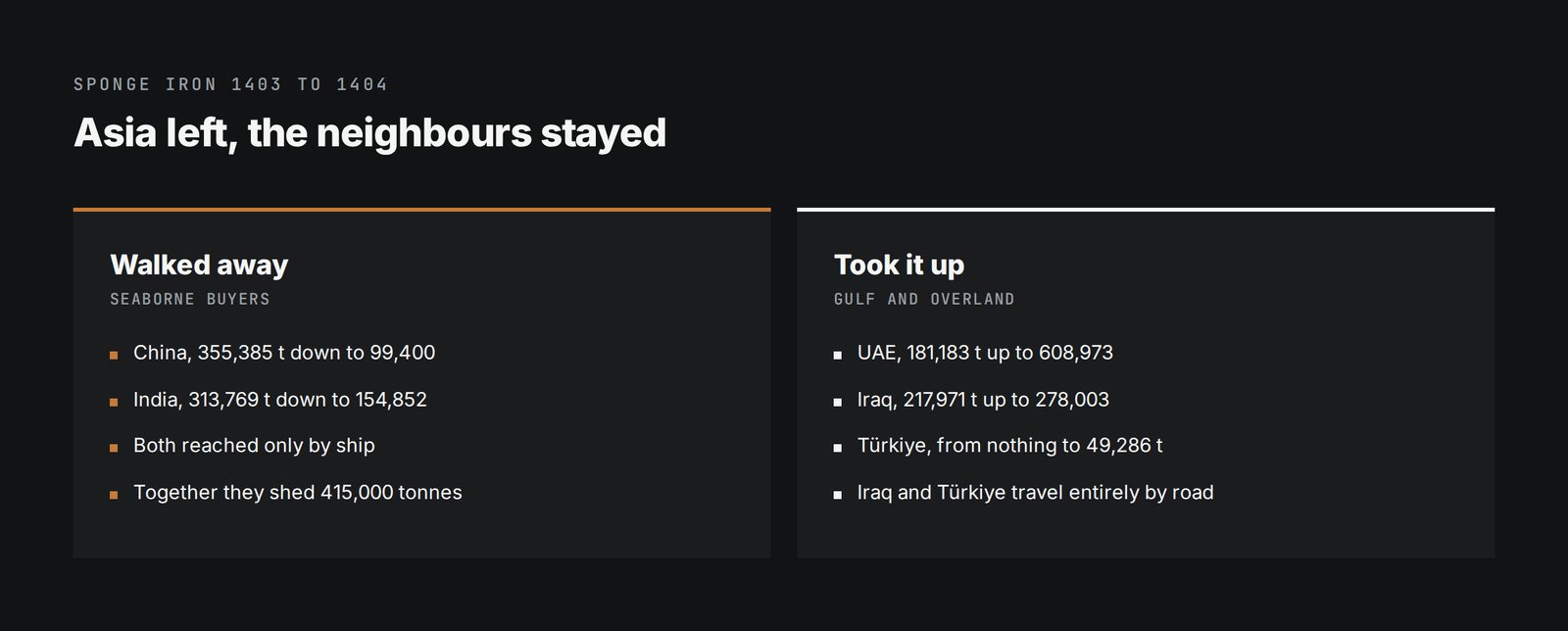
| DESTINATION | PRIOR YEAR | LATEST YEAR | CHANGE |
|---|---|---|---|
| Oman | 602,711 t | 749,449 t | +24% |
| UAE | 181,183 t | 608,973 t | +236% |
| Iraq | 217,971 t | 278,003 t | +28% |
| India | 313,769 t | 154,852 t | −51% |
| China | 355,385 t | 99,400 t | −72% |
| Türkiye | — | 49,286 t | new |
China and India between them dropped 415,000 tonnes. Iran's two largest Asian customers, roughly 38 percent of the trade, halved and then halved again.
The tonnage did not disappear. It went to the Gulf, and it went next door.
Oman and the UAE are not consuming this
Before reading the Gulf numbers as demand, look at their scale. The UAE took 608,973 tonnes, more than tripling in one year. Oman took 749,449. Together that is 1.36 million tonnes, 65 percent of everything Iran shipped.
Neither country has a steel industry that eats sponge iron at that rate. What they have is ports, warehouses and re-invoicing. The material is being transhipped, and where it finally lands is not recorded in Iranian customs data at all.
That pattern is not new and it is not unique to this product. The same structure runs through the ferroalloy trade in the other direction, which this piece on where the tonnage actually comes from sets out in more detail.
Iraq is the one number that means what it says
Iraq took 278,003 tonnes, up 28 percent. Unlike the Gulf, Iraq is an end market: the material goes into furnaces inside the country.
And it gets there entirely by road.
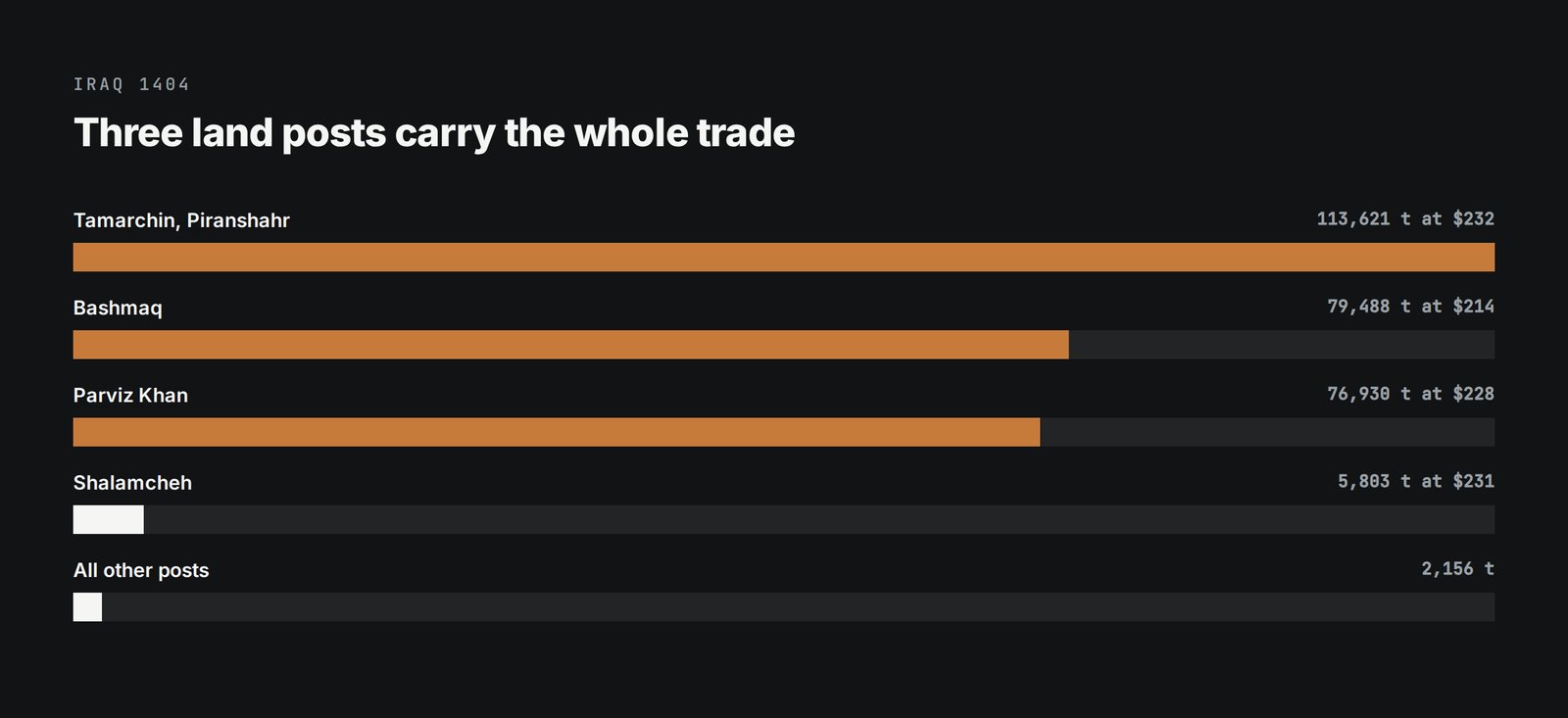
| CROSSING | TONNAGE | SHARE | UNIT VALUE |
|---|---|---|---|
| Tamarchin, Piranshahr | 113,621 t | 42.0% | $232 |
| Bashmaq | 79,488 t | 27.0% | $214 |
| Parviz Khan | 76,930 t | 27.9% | $228 |
| Shalamcheh | 5,803 t | 2.1% | $231 |
Shalamcheh is the Basra door and it carries two percent. Everything else goes north, into Kurdistan.
That follows the furnaces rather than the geography. The electric arc capacity that takes this material sits around Erbil: the Galiawa plant opened in 2022 at a stated 750,000 tonnes a year and runs roughly 20 percent scrap with the balance sponge iron. The Basra state works restarted in 2025 with direct reduction of its own, which is consistent with its border staying quiet.
Bashmaq is the one that moved: 30,782 tonnes to 79,488, up 158 percent in a year, and it is also the cheapest crossing at 214 dollars. Cheapest and fastest-growing at the same time is worth understanding before assuming it continues.
Why the road matters more than the price
Sponge iron averaged 228 dollars a tonne, down 5 percent on the year. Nobody is making a fortune per tonne, and the falling unit value says competition rather than scarcity.
What makes the Iraqi trade work is not the margin, it is the mode.
A 25 tonne truck carrying sponge iron is carrying about 5,650 dollars of cargo. The same truck carrying iron ore is carrying 1,700.
Iron ore at 60 to 90 dollars a tonne cannot pay for road freight. It needs a ship, and for much of 2026 the ships were not sailing. Sponge iron at 228 dollars can, and the proof is that 278,000 tonnes crossed by road last year, roughly thirty trucks a day, while the ports were closed.
That is also why Türkiye appears in the table for the first time, at 49,286 tonnes. The same logic that moves ferroalloys overland through Urmia and Tabriz, which the Turkish market piece covers from the ferrosilicon side, applies here.
What a buyer should ask
If you are looking at this material from outside the region, three questions decide whether an offer is real.
Cold DRI or hot briquetted iron? Cold sponge iron is pyrophoric: it reacts with air and moisture, self-heats, and can ignite. Over a short covered road run it is handled routinely. In a ship's hold it is a different proposition, and HBI exists precisely to solve that. An offer that does not say which form it is has not been thought through.
Which crossing, and whose trucks? Three posts carry this trade and they do not price the same. A 214 dollar crossing and a 232 dollar crossing are an 8 percent spread on a product with a thin margin.
Metallisation, not just iron content. Typical material runs 92 to 94 percent metallisation at 90 to 93 percent total iron, with 1 to 2 percent carbon. Total iron alone does not tell a melter what they are buying.
A note on the figures
These are Iranian customs statistics for the two most recent full years, by tariff line and destination. They record what was declared at the border, which is not always where the material ended up, as the Gulf numbers show.
Two years is also not a trend. What it does show clearly is a direction: the seaborne customers left, and the business that replaced them travels on wheels.