Türkiye imported 136,185 tonnes of ferrosilicon in 2025, up from 109,916 tonnes the year before. A 24 percent rise in a single year, in a market that had been flat.
Iranian shipments into that market fell 18 percent over the same period.
Both of those are true at once, and the gap between them is the story.
What the numbers say
| ORIGIN | 2024 TONNES | 2025 TONNES | SHARE 2025 |
|---|---|---|---|
| Russia | 15,866 | 52,819 | 37.6% |
| Iran | 60,625 | 49,823 | 32.7% |
| Kazakhstan | 14,249 | 11,586 | 7.5% |
| Azerbaijan | near zero | 9,207 | 6.6% |
| China | 10,392 | 5,430 | 5.4% |
| Brazil | 1,460 | 2,560 | 2.5% |
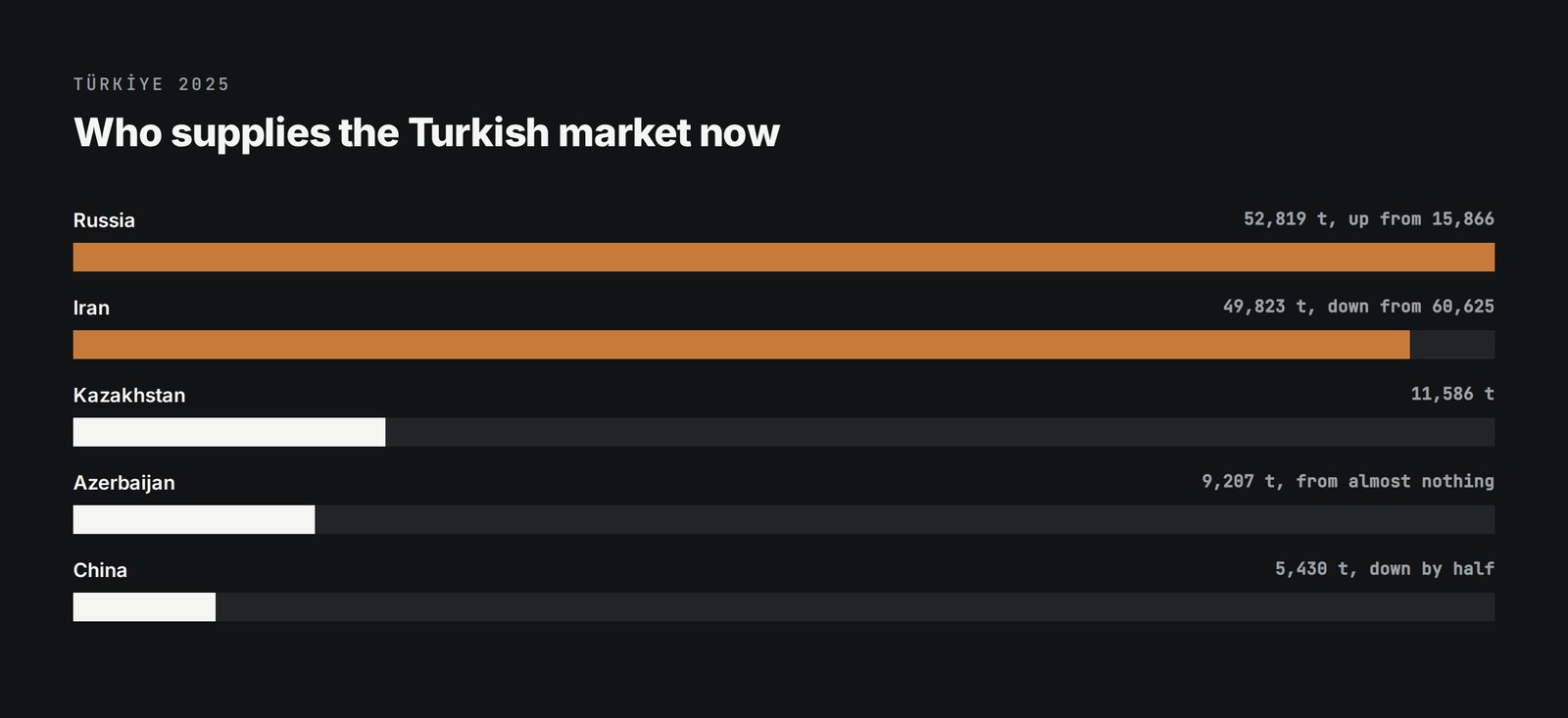
Russian volume more than tripled and took first place. Kazakh and Chinese volume fell. Azerbaijan appeared from almost nothing, which is curious for a country with no significant ferrosilicon capacity.
Unit values fell across the board: Iranian material from 1,051 to 949 dollars a tonne, Russian from 1,165 to 1,030, Kazakh from 1,237 to 932.
Why Russia moved
Russian ferrosilicon lost two of its largest markets in the space of a year.
The United States completed an anti-dumping investigation covering ferrosilicon from Russia, Brazil, Kazakhstan and Malaysia, with a final determination on Russia in September 2024 and a preliminary country-wide rate of 283 percent. The European Union already carries anti-dumping duties of 17.8 to 22.7 percent on Russian ferrosilicon, extended in July 2026 to run to 2031.
Material that cannot clear those two doors has to go somewhere. Türkiye is the nearest large open market with a growing steel sector, and the freight is short.
This is not a Turkish story and it is not an Iranian story. It is a redirection, and Türkiye happened to be where it landed.
A measure aimed at one origin does not reduce demand, it redirects it, which is the pattern trade measures and routing follows every time.
What the numbers do not say
Here is the part a trade table will not tell you, and it matters more than the share column.
Iranian ferrosilicon exports fell to every destination in the same period, not only to Türkiye. Bulgaria down 20 percent, Iraq down 39, Switzerland down 50, Pakistan down 48, the Netherlands down 89. Total Iranian ferrosilicon exports fell 34 percent year on year.
A market that loses share to a competitor loses it in one place. A supplier that ships less to everyone at once has a supply side problem, not a demand side one.
So the honest reading of the Turkish numbers is this: Russian material did not take the market from Iran. It filled a gap that had already opened. The demand was there, growing by a quarter, and part of it went unserved.
What it means for a buyer in Türkiye
Three things follow, and none of them is a sales pitch.
Prices are lower than they were, and softer at the bottom of the market. Every major origin cut its unit value in 2025. If you are buying on a long-standing contract that was priced in 2024, you are probably paying above the current market.
Origin concentration is a risk worth pricing. Two origins now carry seven tenths of Turkish imports, and both of those origins are exposed to trade measures that can change quickly. The buyer who holds one alternative supplier qualified, even without placing volume, pays nothing for that option and holds something real.
Material availability is not guaranteed by a price list. 2025 showed what happens when a supplier cannot ship: the quotation stays the same and the tonnes do not arrive. Ask a supplier where the material is produced and what their own supply looks like, not only what their price is.
For buyers who would rather not open an import file at all, buying inside Türkiye sets out the alternative structure.
Where the figures come from
Import volumes and origin shares are Turkish customs declarations for HS 720221, ferro-silicon containing more than 55 percent silicon, calendar years 2024 and 2025. Iranian export volumes are Iranian customs declarations for tariff 72022110, Iranian years 1403 and 1404.
The two sets will never agree exactly. Calendars differ, and an importer and an exporter never record the same cargo on the same day or at the same value. The direction they show is the same, which is what matters here.